How we ship an investor-ready MVP in 3 weeks
The exact scoping, sprint, and cut-list process we use to take a founder from idea to a demo-able product in 21 days — without the usual agency bloat.
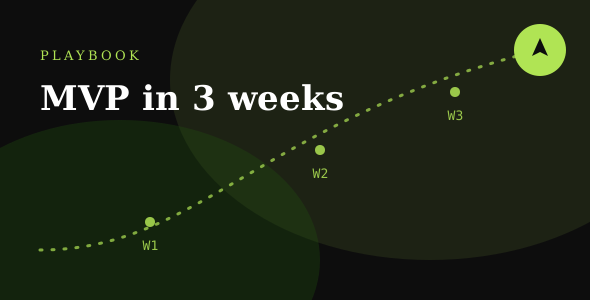
Most teams overbuild their first version. They spend months on settings pages no one will use before a single customer has confirmed the core idea works. Our MVP sprint exists to do the opposite: prove the riskiest assumption fast, with a product real users can touch.
Week 1 — Scope and cut
We start by writing the one sentence the product has to prove. Everything that doesn't directly serve that sentence goes on a "later" list. This single exercise usually cuts a feature wishlist in half. Define the single core loop a user must complete, design only the screens on that path, and defer auth edge-cases, admin tooling, and settings.
Week 2 — Build the spine
With scope locked, we build the happy path end to end: auth, the core action, and the data model behind it. We deploy on day one and keep it deployable every day after. A broken main branch is the most expensive thing in a sprint.
Week 3 — Polish and hand off
The final week is for the things that make a demo land: empty states, loading states, and a single polished flow that feels finished. We hand off a deployed product, the source, and a short walkthrough of how it's wired.
The result isn't a toy. It's a real, narrow product you can put in front of investors or first users — and a foundation you can extend without a rewrite.
Week 1 — Scope and cut
We start by writing the one sentence the product has to prove. Everything that doesn't directly serve that sentence goes on a "later" list. This single exercise usually cuts a feature wishlist in half. Define the single core loop a user must complete, design only the screens on that path, and defer auth edge-cases, admin tooling, and settings.
Week 2 — Build the spine
With scope locked, we build the happy path end to end: auth, the core action, and the data model behind it. We deploy on day one and keep it deployable every day after. A broken main branch is the most expensive thing in a sprint.
Week 3 — Polish and hand off
The final week is for the things that make a demo land: empty states, loading states, and a single polished flow that feels finished. We hand off a deployed product, the source, and a short walkthrough of how it's wired.
The result isn't a toy. It's a real, narrow product you can put in front of investors or first users — and a foundation you can extend without a rewrite.